Beachfront or Riverside in Da Nang? The Honest Trade (2026)
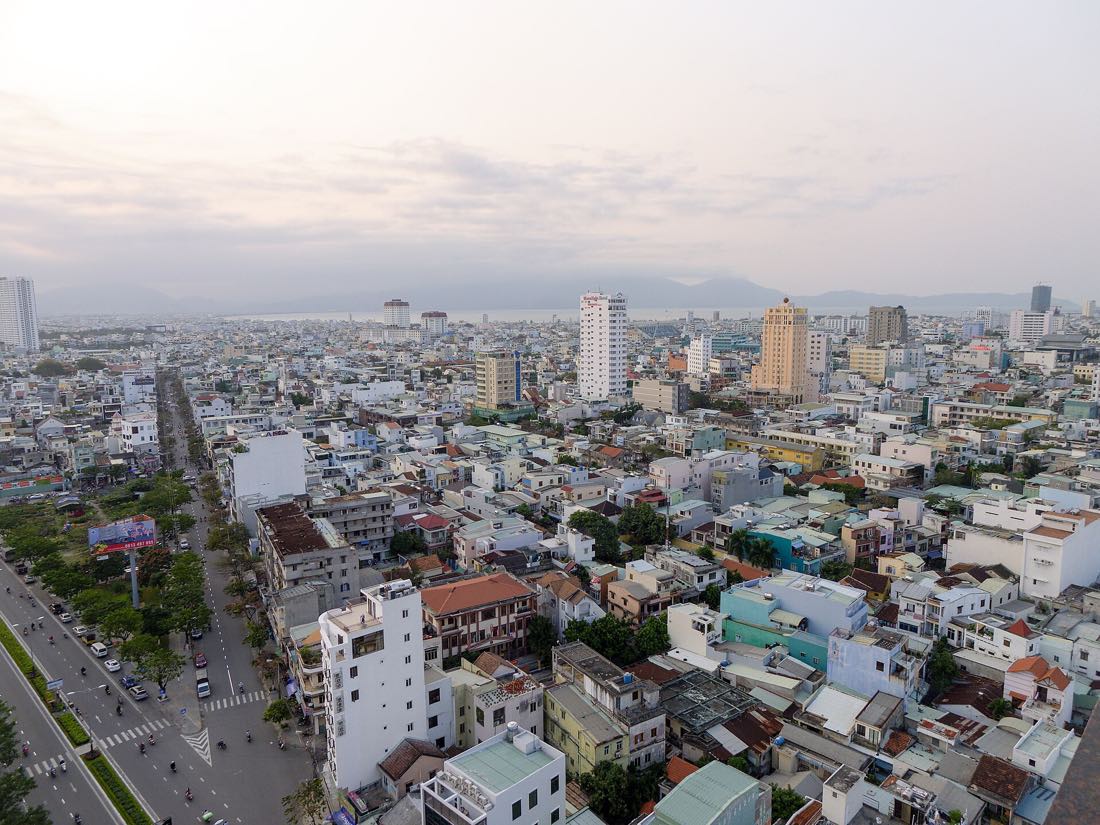
The Hàn River splits Da Nang into two cities. The east bank is a 2–3km strip between river and sea where tourists, expats and nomads concentrate: the My Khe strip, An Thuong, the beach. The west bank is Hai Chau and the working city — 25–40% cheaper, with the real food, the markets and the airport five minutes away. The cost of the west bank is exactly one thing: the beach is 3km away across a bridge, and that is enough friction that most people stop going daily. Short trips should pay the beachfront premium. Long ones almost never should.
Two banks, two different trips
The beach side (east bank)
A 2–3km band between the river and the sea, running from Man Thai at km 2.5 down through My Khe at 4.5 and An Thuong at 7 to Non Nuoc at 12. This is where every tourist, expat and nomad in Da Nang is. Beachfront four-stars $40–60, An Thuong boutique $25–60, hostels from about $10. You get the sand, the 05:00 swim culture and, in An Thuong, the only walkable grid in the city. You pay 25–40% more for all of it. Full verdict →
Compare beachfront hotels ↗The city side (west bank)
Hai Chau and the Bạch Đằng riverfront: the business and administrative heart, and the part of Da Nang locals mean when they say the city. Dorms $5–8, mid-range $25–45, riverfront luxury $60–120, monthly studios $180–300. The best local food and café culture in Da Nang is on this bank, the Dragon Bridge fire show is at your door on Saturday and Sunday, and the airport is five minutes away. The beach is 3km and one bridge, and there is flight noise from about 06:00. Full verdict →
Compare riverside hotels ↗What crossing the river actually costs
Every argument on this page reduces to one of these.
East bank vs west bank on the seven things that decide it
The river is about 400 metres wide and there are four bridges. Nothing here is about distance — it is about which side of the water your default evening happens on.
| Beach side (east) | City side (west) | Winner | |
|---|---|---|---|
| Price | Hostels from about $10, An Thuong boutique $25–60, beachfront four-stars $40–60, sea-view one-beds $600–1,000 a month. | Dorms $5–8, mid-range $25–45, riverfront luxury $60–120, studios $180–300 a month. Consistently 25–40% below the east bank. | City side |
| Beach | Across the road, or a 5–10 minute walk from An Thuong. Lifeguarded flagged sectors, sunbeds about 40,000₫, dawn swim culture from 05:00. | 3km east over a bridge — 10–15 minutes by Grab, 60,000–90,000₫ by car or 20,000–35,000₫ by bike, each way. | Beach side |
| Food | Seafood barns, beach bars, western brunch and Korean in An Thuong. Good range, tourist pricing, thin on the Vietnamese canon. | Con Market, Han Market, the mì Quảng and bún chả cá institutions and most of the Michelin-listed addresses. Dishes 25,000–70,000₫. | City side |
| Airport | 10–15 minutes from the strip. GrabCar 70,000–120,000₫ plus a 30,000₫ airport surcharge. | About five minutes. The single strongest practical argument for this bank, especially on a 06:00 departure. | City side |
| Walkability | An Thuong's eight-block grid and the beach promenade — the two best walking surfaces in Da Nang. | The Bach Dang riverfront promenade is excellent; behind it the pavements are parked full of scooters. | Beach side |
| Noise | Construction and karaoke in An Thuong, boulevard traffic on the strip. Nobody sleeps badly because of the sea. | Flight noise roughly 06:00–23:00 and genuine city traffic. A river-facing room solves most of it. | Beach side |
| Evenings | Beach bars, the An Thuong craft-beer cluster, seafood at 19:00. Weeknights close around midnight. | The Dragon Bridge fire show at 21:00 on Saturday and Sunday, Han River cruises from about $7, Bamboo 2 Bar and the Bach Dang strip. | Draw |
The nightlife on both banks is modest and Reddit's verdict — "snooze fest" — is not unfair. It is a bar town, not a club town, and picking a side of the river will not change that. See the nightlife page.
Who wins, by how long you are staying
Under four nights — the beach side wins
The consensus across years of forum threads is that Da Nang is a 2–3 day city, and nobody argues that is too few. On that timescale you want zero friction between bed and sand, and you will not be here long enough for the 25–40% saving to add up to anything. Book a beachfront four-star at $40–60 and spend the difference on a day trip.
Five nights to a week — genuinely close, lean beach
This is the band where An Thuong resolves the argument: it is on the beach side, it is cheaper than the beachfront, and it has a walkable grid of food and cafés that answers most of what the city side offers. If you want to eat properly Vietnamese every night rather than well internationally, cross the river instead.
Over a week, or a month — the river wins
The saving compounds and the novelty of the sea view does not. Monthly studios run $180–300 on the city side against $300–500 in the An Thuong grid and $450–700 beachfront, the food is better and cheaper, and you can ride to the beach in ten minutes on the days you want it. Nearly everyone who stays past a month ends up either here or in Man Thai.
September to December — the river, regardless of trip length
This is the one that overrides everything else. A red-flagged beach in October makes a beachfront room pointless — you are paying a premium to look at water you are not allowed to enter, in the wettest two months of the year. Hotel rates halve in those months on both banks; take the discount on the side of the river that still works in the rain.
What nobody tells you about the 3km
It is not the distance. It is that the distance turns swimming into a decision.
Three kilometres is a ten to fifteen minute Grab — 60,000–90,000₫ in a car, 20,000–35,000₫ on a bike — and on paper it is nothing. In practice it converts a morning swim from something you do into something you plan, and the number of people who move to the city side intending to swim daily and then swim twice a week is very large. If the beach is genuinely the point of your trip, sleep on the beach and pay the premium. That is the whole of the honest advice.
What you get in exchange is the version of Da Nang that residents rate so much more highly than visitors do. The city side has Con Market and Han Market, the mì Quảng and bún chả cá institutions, most of the Michelin-listed addresses at 25,000–70,000₫ a dish, the café scene that earned this city the "Chiang Mai by the sea" label, and an airport five minutes away. The beach side has a beach and the businesses that exist because of it.
The honest one-line summary of this city: underrated as a base, overrated as a destination. People who live here rate it extremely highly — a workable city with a real beach, cheap food and a 10-minute airport. People who come for four days and expect an old town rate it poorly, and they are not wrong: Da Nang has no ancient quarter and very little traditional architecture, because it was a French port and then an American airbase. Treat it as the base and Hoi An, My Son, Hai Van and the Marble Mountains as the day trips, and the city works. Treat it as the destination and you will be bored by day three.
And the reason the month matters more than the trip length:
Da Nang's year splits cleanly in two and almost no guide says how hard. February to August is dry; September to early December is monsoon. October alone gets about 650mm of rain — more than February through August combined — with November close behind at 430mm and storms running to around 10 December. The compensation is real: typhoons here pass in a day or two, the city drains fast, and 5-star rates can halve. But if you are coming for the beach, late February to April is the answer and it is not close.
One structural note if you are choosing the beach side for the view: Da Nang's high-rise wall along Vo Nguyen Giap means that unless you are in the first row, you cannot see the sea at all. The local criticism is that the city is repeating Nha Trang's mistakes. Whatever you think of the urbanism, do not pay a beach-adjacent rate for a room that faces another building — check the map, not the marketing.
The two banks, in one place
Price both banks before you commit
The gap between them is the entire subject of this page, so check it for your own dates rather than taking the 25–40% figure on trust — it widens in the dry season and narrows during the fireworks festival, when riverside rooms are the tightest inventory in the city.
Beachfront vs riverside FAQ
Is it better to stay near the beach or the river in Da Nang?
The beach for a trip of four nights or fewer, the river for anything over a week, and the river regardless from September to December. The city side is 25–40% cheaper for the same standard of room and has the better food, but the beach is 3km away across a bridge and that friction is real.
How much cheaper is the city side of Da Nang?
25–40% for an equivalent room. Dorms are $5–8 against about $10 in An Thuong, mid-range hotels $25–45 against $40–60 beachfront, and monthly studios $180–300 against $300–500 in the An Thuong grid or $450–700 on the beachfront.
How far is Hai Chau from My Khe beach?
About 3km east across the Dragon Bridge or the Han River Bridge — 10–15 minutes by Grab, roughly 60,000–90,000₫ by car or 20,000–35,000₫ by bike each way. Short on paper, and enough in practice that daily swimming usually stops being daily.
Should I stay by the beach in Da Nang in October?
No. October drops about 650mm of rain — more than February through August combined — and the sea is red-flagged and effectively closed to swimmers from October to December. Take the halved rates on the riverside instead, where the food, markets and museums still work in the rain. See the rainy season guide.
Which side of the river has better food in Da Nang?
The city side, clearly. Con Market's evening food hall, Han Market, the mì Quảng and bún chả cá institutions and most of the Michelin-listed addresses are on the west bank, at 25,000–70,000₫ a dish. The beach side is stronger on seafood and western food and weaker on everything Vietnamese.
Is there flight noise on the riverside?
Yes, roughly 06:00 to 23:00 — the airport is immediately west of downtown, which is also why you can be at the terminal five minutes after checkout. Ask for a river-facing room. On the beach side you are 10–15 minutes out and it is not an issue.
What is the best compromise between beach and city in Da Nang?
Can you see the Dragon Bridge show from a beachfront hotel?
No — the bridge is on the river, 3km west of the strip. The show runs Saturday and Sunday at 21:00 for about five minutes and the bridge closes to traffic around 20:45. Riverside hotels between the two bridges can see it from the room; from the beach side you make a trip of it. Details on the Dragon Bridge page.