Banh Trang Cuon Thit Heo: Da Nang's Expensive Street Dish, Judged
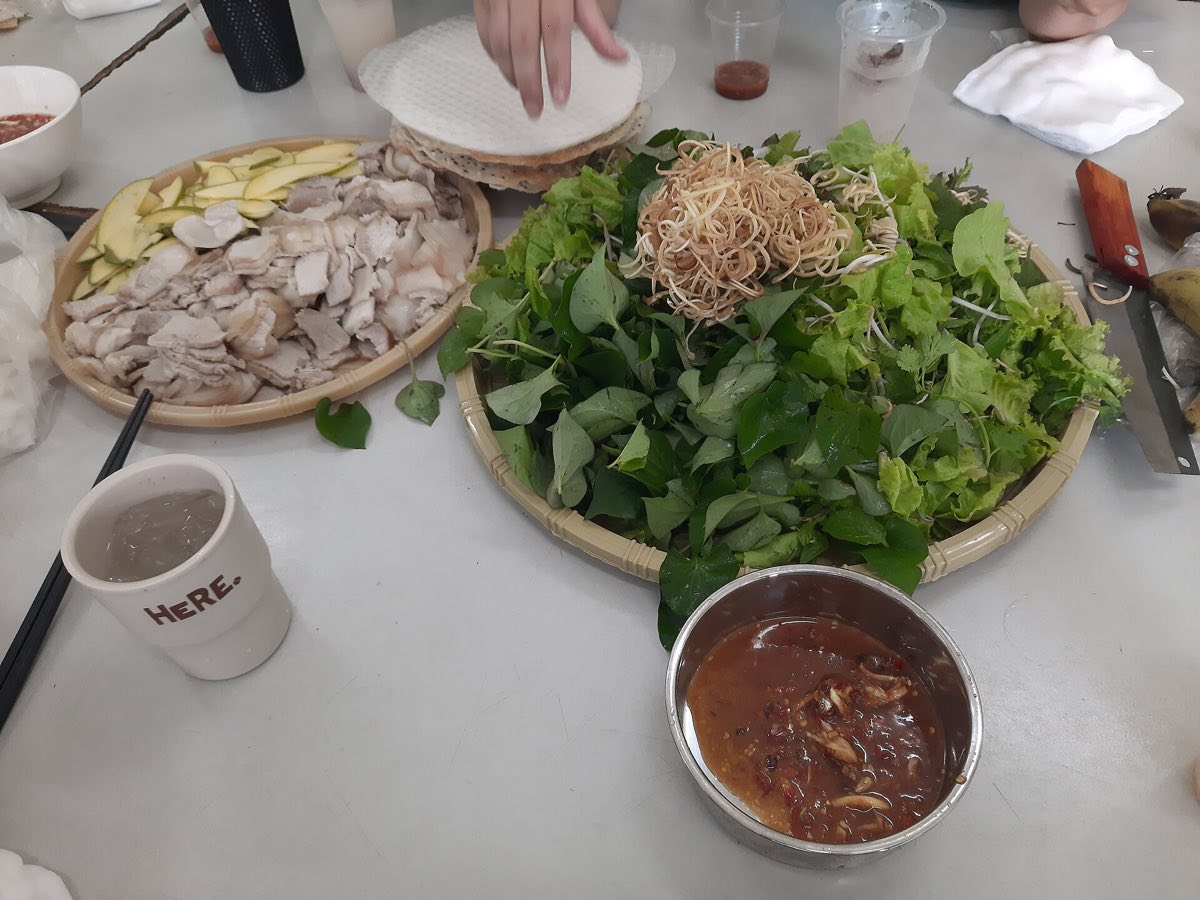
This is Da Nang's expensive street dish — 60,000–160,000₫ (about $2.35–6.30) a portion, against 25,000–70,000₫ for everything else in the canon — and it is the one where the verdict genuinely splits. What you get: boiled pork belly sliced so a seam of fat runs through every piece, two kinds of rice paper, twenty-odd herbs, and a bowl of mắm nêm — fermented anchovy sauce, thick and grey-purple and genuinely pungent. You build every roll yourself, which takes an hour and is the most sociable meal in the city. Đặc Sản Trần is the tourist default at roughly 150,000₫ a set — about double what a neighbourhood shop like Quán Đại Lộc charges for the same thing. If mắm nêm is not for you, this dish is not for you: it is the whole flavour.
Boiled pork, twenty herbs and an hour of assembly
There is no cooking on the table, no broth and no sauce on the food. Everything arrives raw or boiled and separate, and the meal is you putting it together, repeatedly, for as long as you keep going.
The pork is the technical bit. Thịt heo hai đầu da — literally two-skin pork — is a cut boiled and pressed so that each slice carries skin on both edges with a band of fat and lean through the middle. Sliced thin, it is soft, mild and slightly gelatinous, and it tastes of almost nothing on its own. That is deliberate: it is a carrier.
Two rice papers come with it. A soft, damp one to wrap with, and a dry toasted one (bánh tráng nướng) that you break and lay inside for crunch. Doing both is the local way and it is the difference between a decent roll and a very good one.
Then the greens, which arrive as a small hedge: lettuce, perilla, Vietnamese mint, fish-mint, basil, cucumber batons, green banana slices and unripe star fruit. Between fifteen and twenty distinct things, and the astringent fruit slices are the ones visitors skip and should not.
And the sauce: mắm nêm, made from fermented whole anchovy, thinned with pineapple, garlic, chilli and sugar. It is the flavour of the entire dish. Everything else on the table is texture.
Allow an hour. It is slow food by construction and it is the one canonical Da Nang dish that works properly at dinner, when bún chả cá and mì Quảng have both been finished since lunchtime.
Mam nem is fermented anchovy, and it divides people hard
Most guides describe mắm nêm as “pungent” and move on. That undersells it, and people arrive unprepared.
Mắm nêm is whole small fish — usually anchovy — salted and fermented until they break down entirely, then blended rather than strained. It is opaque, grey-purple, and it smells strongly of the sea and of fermentation from a metre away. Vietnamese fish sauce (nước mắm) is the clear, filtered, comparatively mild cousin; mắm nêm is the unfiltered original. Shops cut it with pineapple juice, garlic, chilli and sugar, which softens it into something fruity and savoury and complex — if you can get past the first inhale.
A fair split, based on how this actually goes: roughly a third of first-time visitors love it immediately, a third eat it politely and never order it again, and a third cannot get the bowl near their face. There is no shame in the third group and every shop is used to it. Ask for nước mắm instead — plain fish sauce with lime, chilli and sugar. You will have eaten a good meal. You will not have eaten the dish this city is arguing about.
Useful phrase: không mắm nêm, cho nước mắm — no mắm nêm, fish sauce please. The same sauce turns up in bún mắm nêm, the cold noodle salad sold in the Trần Kế Xương and Đoàn Thị Điểm alley, which is the concentrated version and not where to start.
Where to eat banh trang cuon thit heo, and what each costs
This is the one dish in Da Nang with a real price spread, and the spread is not about quality. It is about air-conditioning, English menus and how far you are willing to travel.
| Shop | Where | Price | What you are paying for | Verdict |
|---|---|---|---|---|
| Đặc Sản Trần | 4 Lê Duẩn · 11 Nguyễn Văn Linh · multiple branches | ~150,000₫ a set (~$6) | The institution and the tourist default. Multiple large air-conditioned branches, English menus, staff who will demonstrate the rolling, consistent quality. Also roughly double what a neighbourhood shop charges for the same components. | DEPENDS |
| Quán Đại Lộc | 97 Trưng Nữ Vương · 124 Huỳnh Thúc Kháng | Local pricing | Best value for quality in the city, and the answer for most people. Same pork, same herb hedge, same mắm nêm, a fraction of the polish and a fraction of the bill. Two locations, both city side. | WORTH IT |
| Quán Mậu | Đỗ Thúc Tịnh, Cẩm Lệ | Local pricing | Trading since 1962 and the heritage name on this dish. It is out in Cẩm Lệ, away from anywhere you were otherwise going, which is why almost no visitor eats here. Worth the taxi if this dish is the point of your evening. | WORTH IT |
| Quê Xưa | 165–167 Núi Thành | Local pricing | Bib Gourmand 2025, and it does mì Quảng under the same roof. The efficient choice when half your table wants noodles and half wants rolls, and the only Michelin-recognised address on this page. | WORTH IT |
| Market stalls | Con Market and neighbourhood markets | From ~60,000₫ (~$2.35) | The cheapest version and a smaller one — fewer herbs, less pork, no ceremony. Fine as a snack rather than a meal, and the right way to find out whether you like mắm nêm before committing to a 150,000₫ set. | DEPENDS |
| A cooking class | Market trip plus a kitchen | Compare classes | Several five-dish syllabuses include the rolling and the mắm nêm blend. Useful mostly because you get to taste the sauce being built from raw fermented paste, which explains a lot about why it tastes the way it does. | DEPENDS |
Prices checked August 2026. The published figures are the 60,000–160,000₫ city-wide band and roughly 150,000₫ for a Trần set; the neighbourhood shops are not individually price-listed, so treat “local pricing” as the lower half of that band. Cash at everywhere except the large Trần branches.
Should you spend a meal on this?
Banh trang cuon thit heo, practically
The sauce makes more sense once you have watched it made
Nothing on this page needs a reservation and a neighbourhood portion costs about 60,000–100,000₫. These are worth it for one specific reason: mắm nêm is the thing people bounce off, and seeing raw fermented anchovy turned into a dipping sauce with pineapple and garlic changes how it tastes.
Banh trang cuon thit heo FAQ
What is bánh tráng cuốn thịt heo?
A Da Nang speciality of thin-sliced boiled pork belly, two kinds of rice paper, fifteen to twenty herbs and vegetables, and a bowl of mắm nêm — fermented anchovy sauce. You assemble every roll yourself at the table. A portion runs 60,000–160,000₫, which makes it the most expensive dish in the local street canon.
Is Đặc Sản Trần worth it?
It is the comfortable version rather than the best one. You get air-conditioning, English menus, several branches and staff who will show you the rolling, at about 150,000₫ a set — roughly double what Quán Đại Lộc charges for the same components. Worth it on a first visit or with people who would not enjoy a plastic-stool shop; not worth it twice.
What does mắm nêm taste like?
Strongly fermented, salty and deeply savoury, with a fruity edge once it has been cut with pineapple, garlic and chilli. It is made from whole anchovies fermented and blended rather than filtered, so it is opaque and it smells assertive from a distance. Roughly a third of first-time visitors love it, a third tolerate it and a third cannot manage it at all.
Can I eat this without the fermented sauce?
You can — ask for nước mắm, ordinary fish sauce with lime, chilli and sugar. Say “không mắm nêm, cho nước mắm”. Be aware that without it the dish is boiled pork, herbs and rice paper, which is pleasant but not what the fuss is about. If mắm nêm is out, bánh xèo is the better use of the meal.
Where do locals eat bánh tráng cuốn thịt heo?
Quán Đại Lộc at 97 Trưng Nữ Vương or 124 Huỳnh Thúc Kháng for everyday value, and Quán Mậu on Đỗ Thúc Tịnh in Cẩm Lệ, which has been trading since 1962 and is the heritage name. Quê Xưa at 165–167 Núi Thành holds a 2025 Bib Gourmand and also serves mì Quảng.
How long does the meal take?
About an hour. Every roll is built by hand from a table of separate components, and the pace is the point. It is the one canonical Da Nang dish that works properly in the evening, since mì Quảng and bún chả cá are both morning food.
Is this dish good for a group?
It is the best group meal in the city alongside bánh xèo. Everything is shared, nobody has to agree on an order, and four people eat well for 300,000–500,000₫ at a neighbourhood shop. It is also the slowest meal here, which is either the attraction or the drawback.
What is the difference between mắm nêm and nước mắm?
Nước mắm is the clear, filtered, aged liquid drawn off fermenting fish — the fish sauce sold worldwide. Mắm nêm is the unfiltered version: the whole fermented fish blended into a thick opaque paste. Same origin, completely different intensity. There is also mắm ruốc, the shrimp version, which turns up on the bún chả cá table.
shop here is
city side.
Trung Nu Vuong, Huynh Thuc Khang, Nui Thanh, Le Duan and Do Thuc Tinh are all on the Hai Chau side of the Han River or beyond it. From a beachfront hotel that is a 40,000-60,000₫ Grab each way, twice, for a dinner that costs 100,000₫. If Da Nang food rather than Da Nang beach is your reason for coming, book across the river: the rooms are cheaper than the $40-60 beachfront four-stars and everything on this page is a walk or a short bike ride away.
Compare Hai Chau hotels